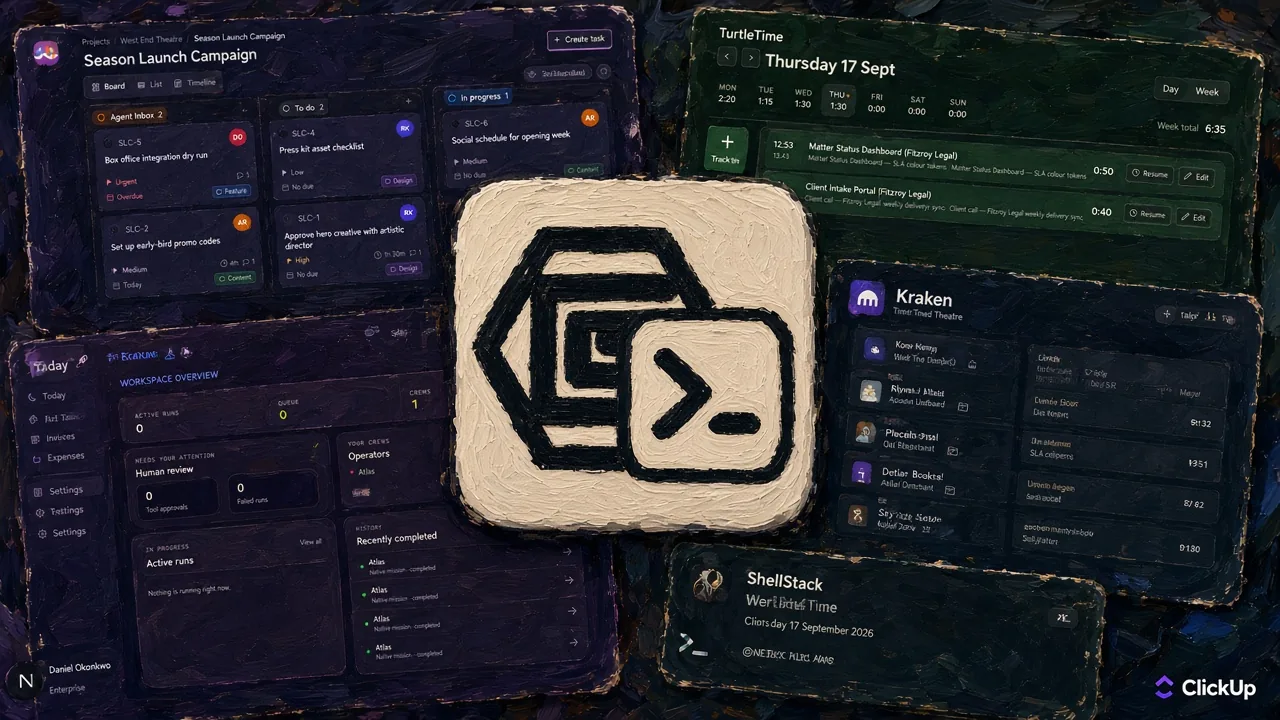
Every comparison of Linear and Jira ends the same way. Linear is the racecar. Jira is the fortress. Cool. I do not run an engineering department. I run client work. The card has a person, a due date, a conversation, and later an hour someone has to invoice. Linear does not care about that hour. Jira will let you plugin your way there until the board needs a part-time admin.
| Topic |  Tides Tides |  Linear Linear |  Jira Jira |  Trello Trello |
|---|---|---|---|---|
| Simple? | Name the columns. Drag a card. Done. | Even simpler, if you accept their defaults | No. That is the product. | The simplest. On purpose. |
| Detailed? | Client, time, docs, agent inbox | Issue, cycle, Git. Not a client. | As detailed as you can stand | A card and some stickers |
| Time | On the task. TurtleTime if you bill. | Not the job | A plugin, usually | Power-Up |
| Who it is for | Studios shipping client work | Software teams | Orgs with process | Anyone with a wall |
| Agent intake | agent-inbox column. Human throws it back. | An issue, if you paste it | A scheme, if you build it | A list you name Inbox |
| Time ledger | Same core.TimeEntry as TurtleTime | Not the job | Tempo or a plugin | A Power-Up |
| Automations | Composio: GitHub assigned → Tides task | Native Git, not your calendar | Automation + marketplace | Butler |
| Documents | Search Kraken from the task | A link, if you remember | Confluence macro | An attachment |
Pick Tides if
The board is how you deliver for a client, and the hour on the card has to mean the same thing as the timer.
Pick Linear if
You are a product-engineering team. You live in GitHub. You want keyboard speed and you will not invoice from the issue.
Pick Jira if
You need schemes, JQL, audit trails, or a customer who already speaks Atlassian. Do not fight that.
Pick Trello if
You want a wall of cards this afternoon and you do not need time, clients or an agent column.
Asana is in this conversation too. It is the cross-functional planner. Fine for marketing and ops portfolios. It still does not know the hour you just tracked. I left it out of the table because the real fork is simple versus detailed, and Asana sits in a third building.
What we kept simple
Statuses you can name. A board, a list, an overview. Assign, comment, attach, move on. No workflow engine. No certification. If your team needs a meeting to add a column, the tool already lost.
What we kept detailed
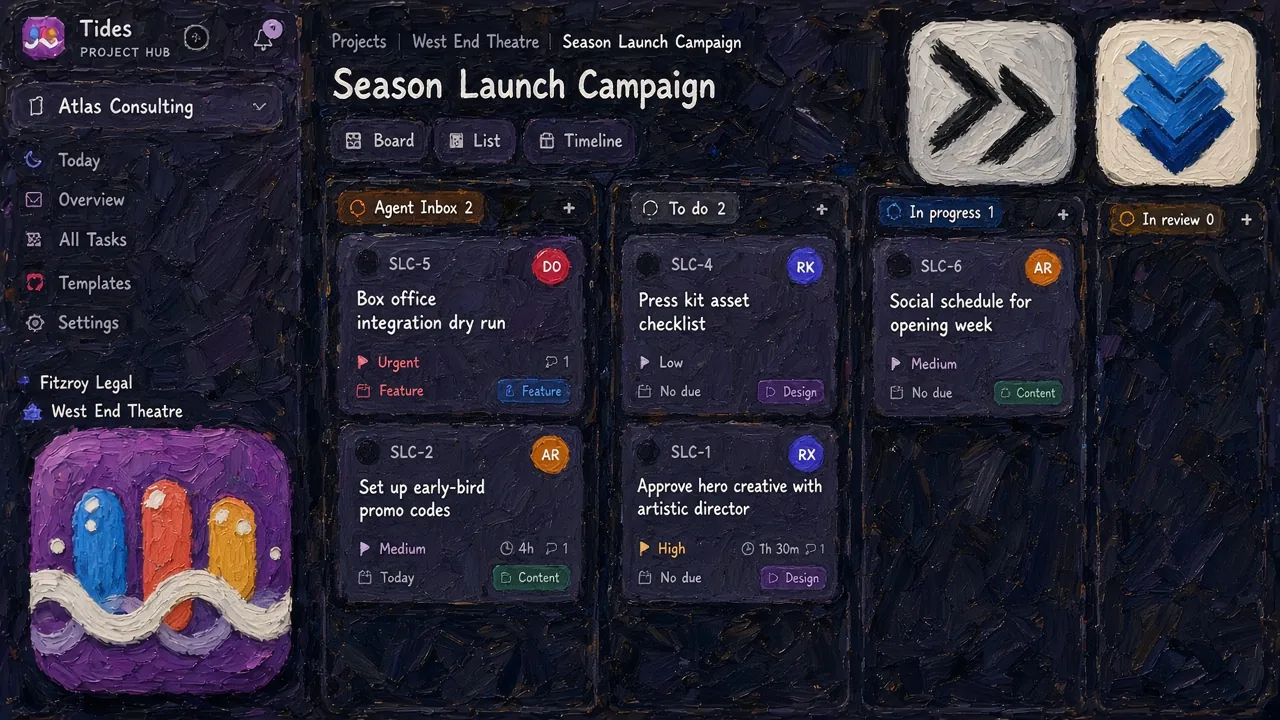
The project belongs to a workspace and usually a client. Time can live on the card. A Kraken page can hang off it. Shelly does not spray tasks into the void — it lands in a column called agent-inbox, and a human can throw it back. That is the detail Linear treats as someone else’s problem, and the detail Jira buries under schemes.
What is actually wired
- Statuses you name, including a seeded agent-inbox slug. Shelly’s intake is that column, not a second product.
- Task time entries write the shared core.TimeEntry ledger. TurtleTime reports them. The JWT is still a Tides JWT.
- A “Track with TurtleTime” deep link carries the task. You do not retype the project name.
- Composio rules (admin/owner): github.issue_assigned can mint a Tides task. Incoming events are idempotent by workspace, provider and external key.
- Projects and tasks can link Kraken documents. Search results still pass Kraken’s visibility, not Tides’.
- Mattermost notifications use a scoped API key. The plugin does not borrow your browser token.
- Board, list and timeline on the same project. BlockNote on the card. Tags, templates, relations, attachments on private Tides R2.
I would rather be a slightly boring board that invoices than a beautiful issue tracker that cannot.
If you are twenty engineers and the work is the repo, use Linear. Seriously. If a regulator wants Jira, use Jira. Tides is for the rest of us: the studio that has a board, a clock, and a client who does not care which framework you like.
Use Tides when you want Linear’s calm without pretending you are a GitHub-only team, and Jira’s substance without hiring a Jira person.